Kelowna's tourism industry recorded mixed results through the third quarter of 2026, with increased visitor spending and short-term rental demand alongside softer hotel performance and declining airport visitor arrivals.
Results from July through September show a strong start to the summer season, followed by widespread declines across several indicators in August and mixed performance in September. Despite these fluctuations, overall visitor spending increased, while short-term rentals recorded higher night demand and average daily rates compared with 2025.
The quarter also coincided with significant wildfire activity across the Okanagan Valley in August, which may have influenced travel decisions and tourism activity during the peak summer season
Hotel Demand Softens During Summer Season
Hotel room-night demand declined 2.5% year-over-year in Q3, while available room-night supply increased, contributing to lower occupancy.
July recorded slightly higher occupancy compared with 2025, followed by a more significant decline in August. September remained below prior-year levels, although the gap narrowed considerably.
August's weaker performance coincided with regional wildfire activity and a strong prior-year comparison. While average daily room rates increased overall, lower occupancy contributed to softer revenue per available room (RevPAR).
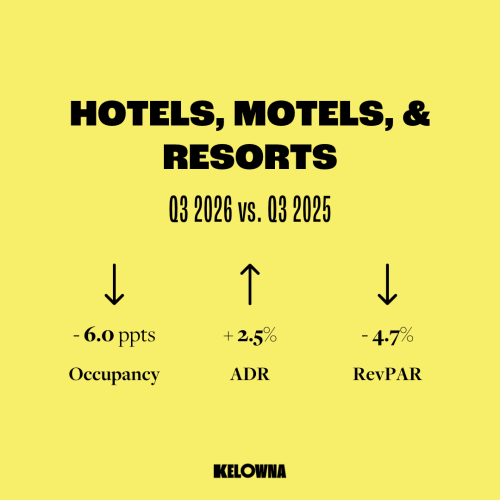
Higher average room rates helped support hotel performance in Q3, although softer demand and occupancy contributed to lower overall results compared with 2025.
Short-Term Rental Demand Increases
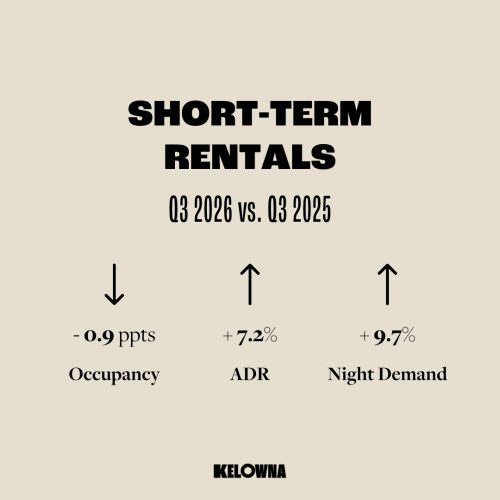
Short-term rental night demand increased 9.7% year-over-year in Q3, contrasting with softer hotel demand during the same period.
Available night supply grew faster than demand, contributing to slightly lower occupancy despite an increase in booked nights. Average daily rates also increased across the quarter.
Occupancy improved year-over-year in July and September but declined in August, reflecting the broader slowdown across several tourism indicators during the month.

YLW Visitor Arrivals Decline
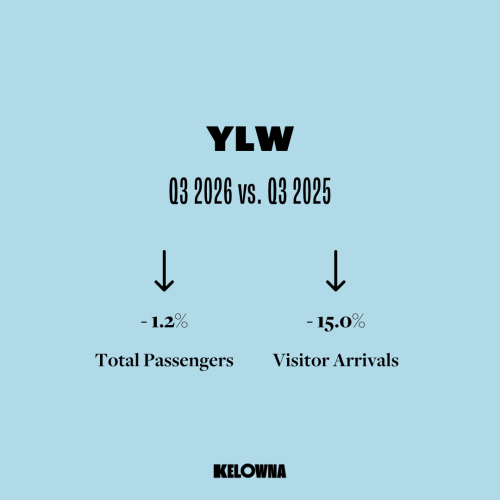
Total passenger volumes through Kelowna International Airport (YLW) declined slightly in Q3 compared with 2025.
Passenger traffic increased in July and September but declined significantly in August. Visitor arrivals followed a different pattern, decreasing throughout the quarter and finishing 15.0% below 2025 levels.
The differing trends between total passenger volumes and visitor arrivals highlight the importance of examining multiple indicators to understand airport activity.
Note: Visitor arrivals represent inbound travellers arriving at YLW who stay in the destination for leisure, business, visiting friends and relatives (VFR), or group travel. Unlike total passenger volumes, this measure excludes other airport traffic.
Visitor Spending Grows Despite August Slowdown
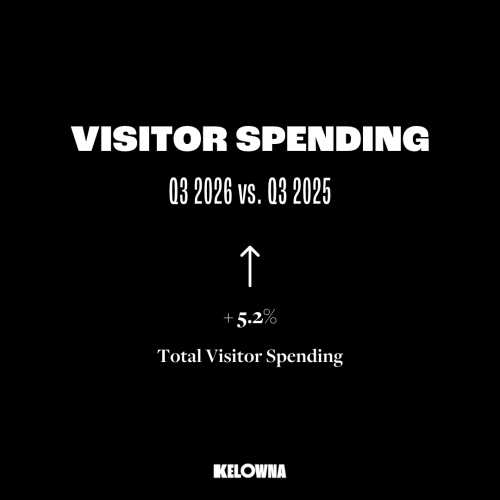
Visitor spending increased 5.2% year-over-year in Q3, with growth across all five spending categories.
Spending increased strongly in July, declined across all categories in August, and returned to positive year-over-year growth in September.
Recreation and Entertainment and Retail recorded the strongest quarterly percentage growth, while Accommodations, Food and Beverage, and Transportation also contributed to overall gains. Stronger results in July and September helped offset August's declines, supporting overall spending growth for the quarter.
Despite a slowdown in August, visitor spending increased 5.2% year-over-year in Q3, with growth across all five spending categories.
Visitation Data to Follow
Complete visitation data, including total trips, visitor nights, and average nights per trip, is not yet available for Q3 2026.
Tourism Kelowna will report on these indicators once complete visitation data becomes available. The results will provide further insight into how visitor volumes and length of stay relate to accommodation performance, airport arrivals, and in-destination spending.
Looking Ahead
Q3 results reflect a mixed summer season for Kelowna's visitor economy. Growth in visitor spending and short-term rental demand contributed positively to tourism activity, while softer hotel performance and declining airport visitor arrivals highlight areas to monitor.
The widespread declines recorded in August, coinciding with regional wildfire activity, also reinforce the importance of destination resilience and adapting to changing travel conditions.
As Kelowna moves into the fall and winter seasons, major events, meetings, conferences, and seasonal experiences provide opportunities to attract visitors and support local businesses beyond the peak summer months. Tourism Kelowna will continue working alongside industry and community partners to encourage year-round visitation, strengthen the visitor economy, and support Kelowna's position as a sustainable four-season destination.
Data Notes & Methodology
Data in this report is drawn from Tourism Kelowna’s Tourism Industry Indicators for Q3 2026 and reflects year-over-year comparisons with Q3 2025 unless otherwise noted. Indicators include hotel performance, short-term rental activity, total passenger volumes and visitor arrivals at Kelowna International Airport, and visitor spending estimates. Complete visitation data for the quarter is not yet available and will be reported once the data set is finalized.
The industry indicators reported above draw on multiple third-party data sources, which are periodically updated. The organizations providing these industry indicators may also refine their modelling methodologies over time, which may result in previously reported data being revised. The industry indicators listed above represent the best available estimate at the time of reporting.