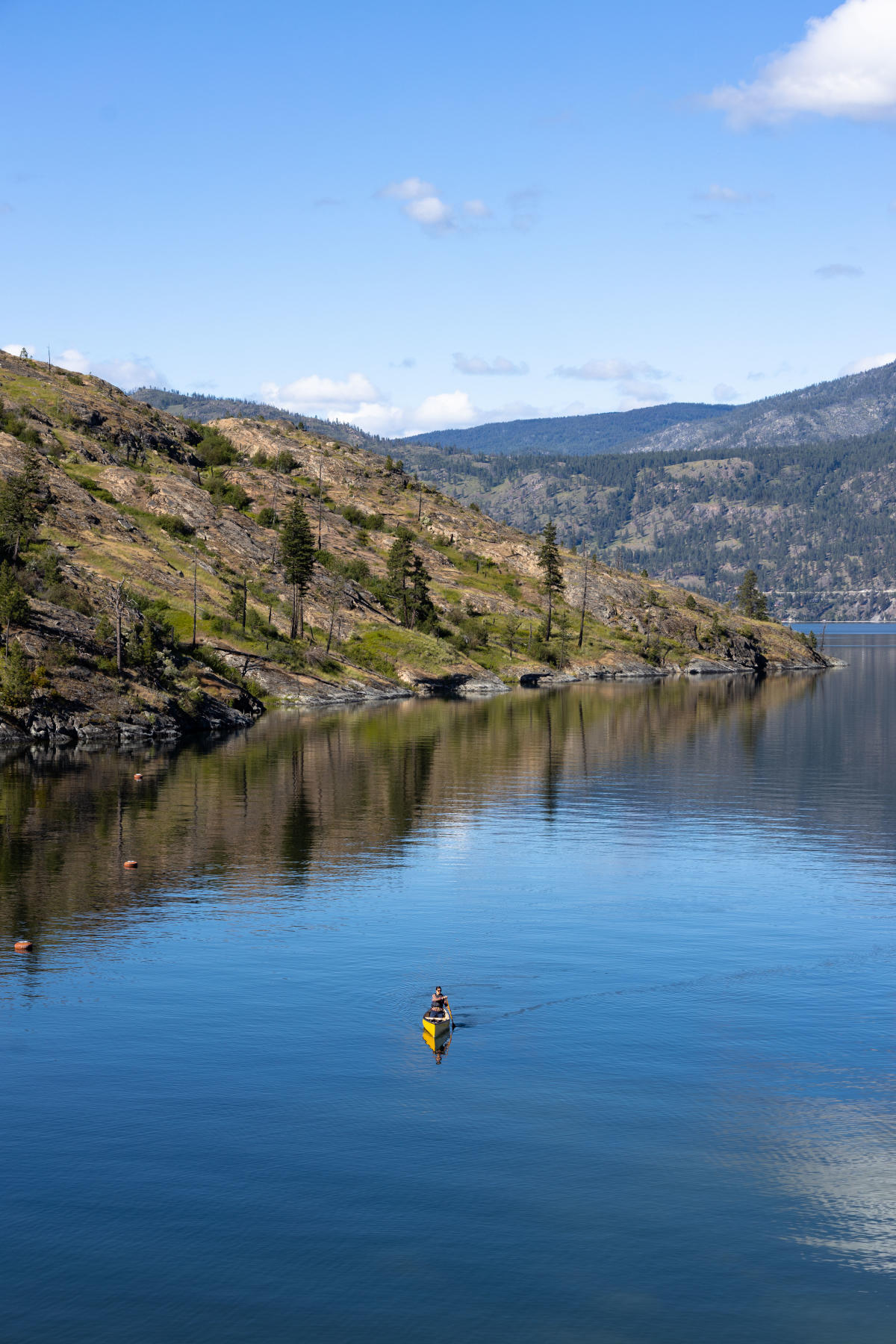
Okanagan Lake, known in nsyilxcən as kɬúsx̌nítkw, is more than a scenic backdrop. For the syilx/Okanagan people, it is a living being with spirit, power, and teachings that have guided generations. Stories of the lake’s sacred presence remind us to respect the waters, the land, and the balance between people and nature.
Many visitors know of the “Ogopogo,” often described as a mythical lake creature. But within syilx tradition, the being is known as nx̌aʔx̌ʔitkʷ—the sacred spirit of the lake. This is not a novelty or legend, but a teaching carried through oral tradition, passed carefully from one generation to the next. These stories remind listeners of responsibilities: to travel safely, to give thanks, and to uphold a relationship of reciprocity with the land and water.
For thousands of years, families offered tobacco or other gifts when crossing kɬúsx̌nítkw, honouring nx̌aʔx̌ʔitkʷ and seeking safe passage. Today, the practice continues to hold meaning, reminding both locals and visitors that these waters are alive with spirit. To treat nx̌aʔx̌ʔitkʷ lightly is to miss the deeper truth, that all beings are connected, and that people must respect the balance that sustains life.
Learning about the spirit of the lake offers a deeper way to connect with Kelowna’s landscapes. It is an invitation to slow down, to acknowledge that this is not just water, but a sacred place. Whether paddling a kayak, swimming at the beach, or standing at the shoreline, being mindful of nx̌aʔx̌ʔitkʷ can transform a visit into a more meaningful experience.
1
2
3
(1) View of Okanagan Lake. Mathew Wanbon, (2) Sunset over Okanagan Lake. Matt Ferguson, (3) Canoeing on Okanagan Lake. Mathew Wanbon
To explore further, visit the Sncewips Heritage Museum in Westbank First Nation or the Okanagan Heritage Museum, where syilx stories and perspectives are honoured. Guided Indigenous experiences also provide opportunities to hear teachings directly from knowledge keepers, offering cultural context that goes far beyond the surface.
Okanagan Lake stretches for 135 kilometres, shaping both the geography and identity of Kelowna. Yet for the syilx/Okanagan people, kɬúsx̌nítkw is not measured by length or depth; it is known through story, spirit, and responsibility. To learn about nx̌aʔx̌ʔitkʷ is to understand Kelowna with new eyes, connected to something far greater than a view.